we love paros
A Quiet Corner of Wings
The Butterfly Valley near Psychopiana, Paros
zazala team
photo: specials.digital
4 minutes read

H
idden in the hills just outside Parikia, between olive groves and pine trees, lies a place of unexpected stillness, the Valley of the Butterflies. Known locally as Petaloudes, this shaded, green ravine is home to thousands of Jersey Tiger moths that gather here in the height of summer.Unlike the open beaches and sun-scorched plateaus of Paros, the Butterfly Valley is a world of filtered light and gentle sounds. A narrow footpath winds through the woods alongside a stream, with wooden bridges crossing above pools and rock beds. It is quiet, cooler than the rest of the island, and offers a rare kind of intimacy with nature.
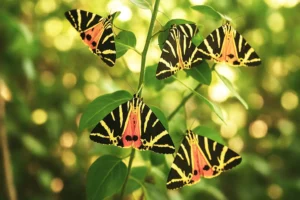
The moths are drawn here by the humidity and the scent of the plane trees, clinging to trunks and leaves in dense patterns. When undisturbed, they rest completely still, but with the slightest motion, they flutter into a sudden wave of black, orange and white. It feels almost choreographed.
Beyond the moths, the valley is also a refuge for walkers, families, and anyone seeking a change of pace. There is a small museum at the entrance and benches along the way. You won’t find loud signs or busy cafés, only the rustle of wind in the leaves and the distant hum of summer insects.
A Lifecycle in Leaf and Light
The Jersey Tiger moth (Euplagia quadripunctaria) is not actually a butterfly, but a diurnal moth that gathers in the valley between June and early autumn to spend the final weeks of its life cycle. Drawn by the humid microclimate and the sweet scent of Oriental Sweetgum and plane trees, the moths hover close to the valley’s natural spring. They conserve their remaining energy by resting in clusters on trunks and rocks, revealing their vivid red underwings in flight before eventually dispersing to mate in late summer.
Although their presence creates a surreal tapestry, it is also fragile. These moths do not feed in their adult stage, relying solely on fat reserves gained during their caterpillar phase. Even a minor disturbance, like loud noises or sudden movement, can cause them to flight, and deplete their energy reserves, endangering their ability to reproduce. For this reason, the Butterfly Valley enforces a conservation-first policy: visitors must speak softly, stay on marked paths, and avoid startling these delicate creatures.
Established as a nature reserve in the late 1970s, the Butterfly Valley spans roughly 800 m in length and is open to the public from June to September for a modest entrance fee, which supports conservation efforts and facility maintenance. The site also includes a small visitor centre with educational exhibits, a café shaded by centuries-old trees, and a playground, making it a peaceful escape for families and nature lovers alike.