we love paros
Voices of the Past
The Archaeological Museum of Paros in Parikia
zazala team
photo | Specials Digital Athens
4 minutes read

T
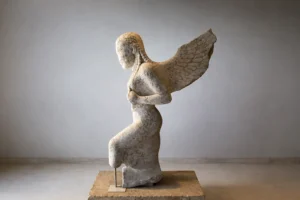
he Archaeological Museum of Paros, discreetly located behind the Church of Ekatontapyliani in Parikia, offers an intimate encounter with the island’s ancient past. Though modest in size, it holds some of the most important finds from Paros, Antiparos, and Despotiko, spanning from the Neolithic era to the Roman period.Inside, visitors encounter the impressive Gorgon of Paros from the 6th century BC, the elegant Nike from the Classical era, and the unique Parian Chronicle, a marble inscription that records a blend of myth and historical events. The museum also houses Cycladic figurines, pottery, reliefs, inscriptions, and funerary artifacts.
The architecture is simple and allows for a focused experience. Natural light filters softly through the rooms, and in the small courtyard, mosaics, lion sculptures, and fragments of temples rest under olive trees. The environment is quiet and respectful, inviting reflection rather than spectacle.
This is not a museum that overwhelms with scale, it captivates through precision. It tells the story of an island that was once at the heart of marble carving, myth-making, and seafaring trade. It is an essential stop for anyone seeking to understand the deeper layers of Parian identity.
The Parian Chronicle: A Marble Timeline of Myth and History
One of the museum’s most significant artifacts is the Parian Chronicle (Marmor Parium), a marble stele inscribed in Attic Greek that offers a unique blend of mythological and historical events. This chronicle spans from the reign of Cecrops, the legendary first king of Athens, around 1581 BCE, to the archonship of Diognetus in 264/263 BCE. The entries detail the establishment of festivals, the introduction of various forms of poetry, and the births and deaths of notable poets, providing invaluable insight into how the ancient Greeks perceived their past .
Paros was renowned in antiquity for its high-quality, semi-translucent white marble, known as Parian marble, which was highly sought after for sculpture and architecture. The museum’s collection showcases this local craftsmanship through various artifacts, including the Gorgon of Paros, a 6th-century BCE marble statue depicting the mythical creature Medusa, and the Nike of Paros, an early classical representation of the goddess of victory from around 470 BCE . These exhibits not only highlight the technical skill of Parian artisans but also provide a tangible connection to the island’s historical significance in the broader context of Aegean civilization.